Ylyas Nurmuhammedov
About me

Nice to meet you — I'm Ylyas

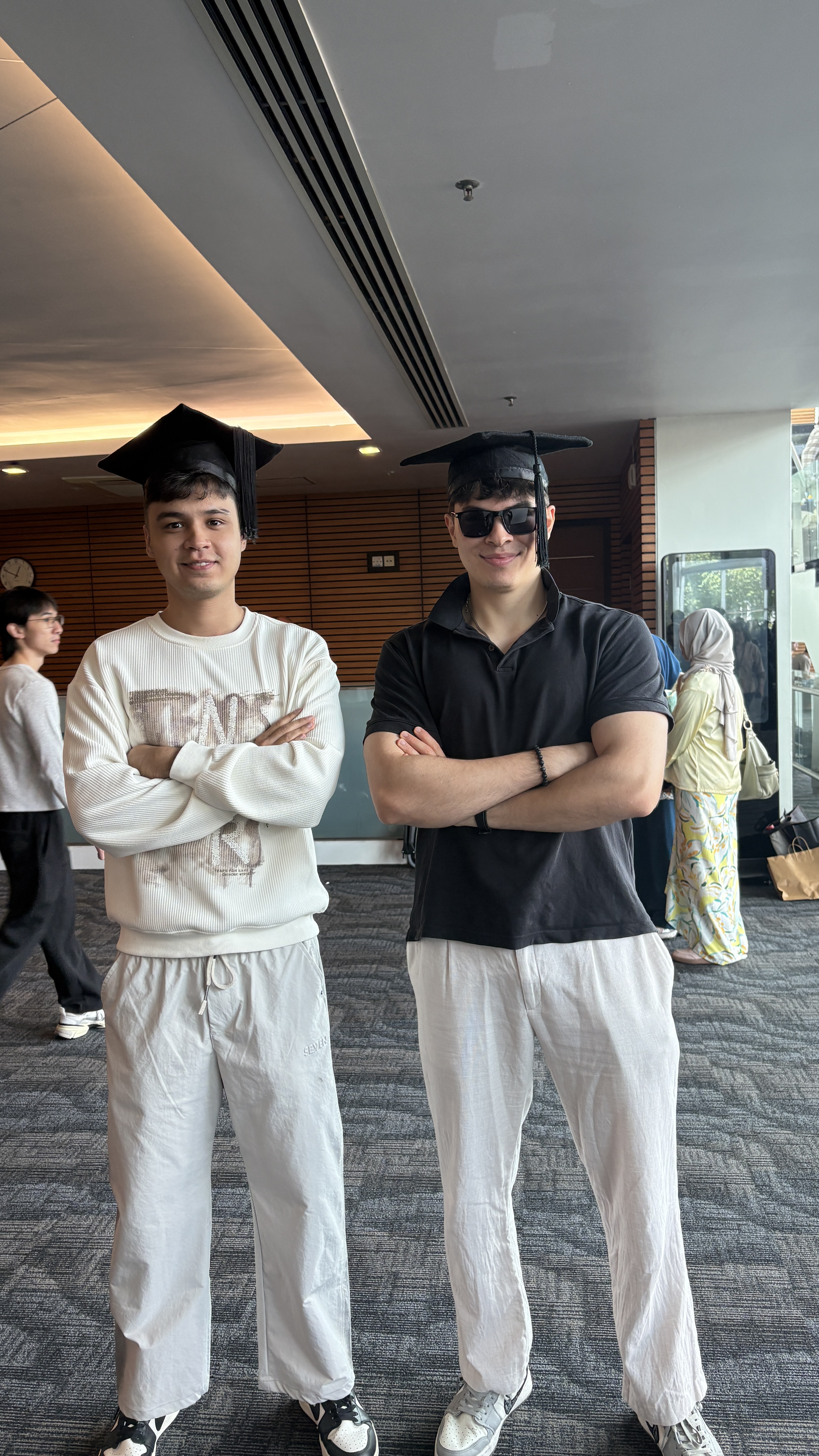
I'm a 23-year-old software engineer and entrepreneur from Turkmenistan, currently living in Malaysia. I build across the entire stack, but I’ve always gravitated toward the heavy lifting most people skip: designing complex databases, locking down access control, and making sure infrastructure doesn't collapse when things go completely wrong in production.

Over the past two years, I’ve shipped three very different production systems built for high-pressure environments: a solo-engineered enterprise tax compliance platform during my internship at Syarikat Tajau Berseri, an AI-driven campus application deployed directly for Swinburne University of Technology Sarawak, and an IoT network defense system built after walking the physical rainforest perimeters it now safeguards at the Semangoh Wildlife Centre.

My engineering approach is backed by a solid understanding of networking and system security, built while completing all three Cisco CCNA certifications. I write code with a defender’s mindset: I automatically assume a system will be targeted and misused, and I architect the codebase so that it simply doesn't matter.

My story

Who am i?

A resume tells you what tools I can use. This section is about how I think, how I handle pressure, and what drives me to build.

01

Learning to execute from absolute zero

I learned what it means to build things by watching my father. He’s been an entrepreneur his entire life, starting at just 17 years old. He began with absolutely nothing—selling homemade milk on the streets—and fought his way up to establishing one of the top construction companies in Turkmenistan. He didn’t have a business degree or a manual when he started; he just executed, learned from every mistake, and adapted on the fly.

After high school, I stepped into that world for a year to test myself. Working inside his construction company, I spent every single day with a mentor who forced me into tough environments early on. He taught me the underlying human side of business—how to talk to people, master communication skills, and ensure a critical message actually lands when you deliver it.

Within four months, I went from just listening to actively operating. I was handling government licensing, bidding on public tenders, navigating sales negotiations, and helping with the corporate hiring process. Sitting in the main boardroom meetings, I spent hours analyzing how people communicated—how often they spoke, when they chose to hold back, and how they shifted the room. I realized very quickly that the most powerful leverage in business isn’t speaking the loudest; it’s being genuinely interested in the person across from you and actually listening to what they need.

02

My first business

Once I understood how government legalities and corporate frameworks operated, my mentor and I spotted a massive, painful problem in our local market. Thousands of aspiring founders desperately wanted to launch startups, secure patents, or legalize their companies, but they were completely paralyzed by the bureaucratic nightmare. They had no idea which department to visit, which documents to file, or how to navigate the paperwork. Most gave up before they even started.

We built a solution for them. We went directly to each major government department and negotiated streamlined, back-end channels to process corporate registrations from scratch. We turned a multi-month administrative headache into a sleek, 2-to-3-week service, and we charged good money for it because we were solving a massive frustration.

After our first two clients, word spread fast. Our phones wouldn't stop ringing, and our operation scaled 3x to 5x almost overnight. The volume grew so fast that I brought in my cousin and a crew of his friends to help manage our document pipelines. These guys were 7 to 10 years older than me, but they were jobless at the time and saw the incredible momentum we had created. For six months, we ran that niche, expanded our services, and became well-known. That was the moment I realized that the instinct to build, automate, and solve market problems was permanently in my blood.

03

Going further in life

I had a highly profitable business running smoothly in my home country, but I refused to let myself get comfortable. I was young, and I knew that if I stayed where things were easy, my growth would stop. I wanted to see the world, explore untouched environments, and live a completely independent life abroad.

There is a massive mental shift that happens when you pack your life into bags and move halfway across the world alone. When you physically widen your horizon, your entire cognitive engine expands with it. Your ideas grow larger, your problem-solving adapts to global dimensions, and your analytical skills sharpen because you no longer have a safety net. That is exactly why I left the day-to-day operations of my business behind and moved to Malaysia to pursue my computer science degree at Swinburne University.

I wanted to prove that I could build something from zero in a place that owed me nothing—a new country, a new language, and a completely unfamiliar technical field.

04

Getting comfortable with being uncomfortable

Throughout my entire four-year degree, I was constantly thrown into high-pressure projects where I had zero baseline knowledge. I was forced to handle complex stakeholder requirements, conduct market research, and understand deep software problems from a strict business perspective. I had to figure out how to solve problems people actually faced—or better yet, engineer solutions to problems the market didn't even realize they had until the product was sitting right in front of them.

Following a university syllabus is something anyone can do. But you can't teach the drive to go out and chase down the exact things the syllabus completely missed—that's the only skill that actually compounds long-term. My eyes were constantly on fire for the unknown—driven by an intense hunger to learn a framework I’d never heard of, implement it, and seamlessly merge it with existing technologies.

The speed I bring to my technical engineering is directly fueled by the intense discipline I demand from my physical life. Living entirely on my own, I took total ownership of my health—completely rebuilding my physique through high-intensity weightlifting, running, swimming, and meticulous nutrition tracking.

Then in 2025, I stepped into a boxing gym, and my relationship with discomfort changed forever. Weightlifting is predictable; boxing is unyielding chaos. It drags you straight to your absolute physical limit within minutes and forces you to think rationally, analyze your opponent, and make logical decisions while your lungs are suffocating.

The real test of this mindset came during grueling 6-to-10-kilometer elevation hill runs. As someone who wasn't a natural runner, every single step was pure psychological warfare. When my shins, quads, and lungs were begging me to stop and lie down, I would force myself to ask simple questions: Are my legs physically broken? Has my body completely collapsed? No. I was still entirely capable of moving. Pushing past that imaginary mental barrier in the ring or on a steep hill is the exact same loop I use when debugging a complex system, tracing a network failure, or deploying an architecture under a crushing deadline.

"The limit is never physical. The limit is a lie your mind tells you because it wants to stay comfortable. Pushing past that point — in the gym, in the ring, or in a codebase — is the only place where growth actually happens." — the lesson I carry into everything I build
05

The real lesson wasn't the business — it was the room

People look at that side hustle and assume the biggest takeaway was just learning how to grind. It wasn't. The real education was about how people think, though it took a long time to actually put words to it.

Being only eighteen meant sitting across from clients twice my age who wanted to start a business but were completely stuck. The government bureaucracy back home is incredibly complicated; trying to handle it alone means months of running around to ten different departments just to get an official company stamp. Because there was zero information online, it was easy to spot a massive gap in the market with huge financial potential.

At first, being a teenager with no track record made things difficult. But a habit I'd picked up from watching boardroom meetings months earlier changed everything: stop trying to look smart, and just listen to what the person across from you is actually worried about.

When people called asking for a food license or an industrial gas license, the paperwork wasn't the priority. They were really paying to get rid of the stress and the constant run-around. Once it became clear that peace of mind was the real product, pricing conversations got simple. Trust isn't built by pretending to know everything; it happens when the person across from you realizes their specific headache is completely understood before a solution is even offered.

The business scaled fast, jumping from a single client to five or six calls a week. Managing it alone became impossible, so along with my cousin and his crew, I brought on a couple of high school graduates to help handle the load. We broke the volume down into specific tasks, assigned them out, and focused entirely on giving clients flat prices and clear timelines. It was a fast-moving side hustle, so we didn't even need to register it officially.

Even so, the money earned was always meant for a bigger purpose. Every single dollar saved was intentionally set aside to fund a move abroad, get a degree in cybersecurity, and experience living independently in a completely new environment.

A week before my flight, I handed the entire operation over to my mentor. Today, he and my cousin are still running it and growing the operation. The money I earned didn't just pay for a flight; it fully covered my laptop and my entire first year of living expenses in Malaysia while starting my degree. But looking back, the real leverage was the insight I took from those rooms—knowing how to spot an unserved market, build trust as the youngest person around, and solve the unexpressed problem. That exact same framework is what I bring into engineering and team code reviews today.
Where I'm going next

Making AI work in production

That same habit of looking for gaps—the one that turned messy government paperwork into a business—is exactly what draws me to AI infrastructure now. Moving AI out of isolated research environments and into secure, real-world corporate deployment is the defining technical challenge of this decade.

🔐

Architecting for real-world security

Deploying transformative AI introduces entirely novel attack surfaces and complex data-handling vulnerabilities. Specializing in network defense and application security, I prioritize structural protection from the very first line of code — integrating models behind robust system designs that shield data integrity without compromising performance.

🛠️

Full-stack execution that scales

Turning an AI concept into a production-ready application requires comprehensive full-stack execution. Having engineered full-scale architectures utilizing TypeScript, Python, SQL, and robust cloud environments, I build optimized data pipelines and scalable backends designed to handle heavy semantic workflows efficiently.

⚡

Moving at the speed of the industry

The exponential pace of AI development requires engineering teams to adapt and pivot constantly. I thrive in high-velocity environments — rapidly prototyping, mastering emerging model architectures, and moving from theoretical design to shipped, production-grade code faster than the market expects.

What I've actually shipped

Toolbox

Languages & Frameworks

TypeScript Next.js React Python

Databases & Cloud

PostgreSQL Supabase Firebase Vercel

Security & Hardware

🛡️ Network Defense Cisco CCNA 🔑 JWT Auth 🌐 REST APIs Arduino / ESP32
Experience

The systems running right now

💼

Full-Stack Developer (Internship) — Syarikat Tajau Berseri

Sole Developer on SmartTaxApp · December 2025 – Present

Engineered a full-scale SST production tax compliance platform. Designed the comprehensive PostgreSQL schema, implemented granular Row-Level Security (RLS) policies, and engineered a database-driven tax resolution engine featuring an automated weekly classification pipeline. Supervisor feedback specifically highlighted proactive problem-solving and rapid feature delivery.

🎓

Final Year Project Lead — Swinburne University

Lead Architecture & Security Engineer · 2025 – 2026

Deployed a comprehensive campus application built entirely from real student survey data. Architected the core navigation patterns, built the secure AI campus assistant backend, and performed rigorous security validation, including simulated DDoS attacks, API flooding tests, and strict rate-limiting policies.

🦧

IoT & ML Developer — Semangoh Wildlife Centre

Client System Engineer · 2025 – 2026

Designed and deployed an edge-computing intrusion detection device built on an ESP32 hardware architecture (M5Stack Fire). Engineered a real-time ranger monitoring dashboard in React and trained a custom plant identification machine learning model on labeled image data, designing the entire setup around the physical constraints of the active rainforest zones it protects.

Certifications

Certifications & Professional Development

CCNA: Introduction to Networks badge

Introduction to Networks

Cisco Networking Academy
CCNA: Switching, Routing, and Wireless Essentials badge

Switching, Routing & Wireless Essentials

Cisco Networking Academy
CCNA: Enterprise Networking, Security, and Automation badge

Enterprise Networking, Security & Automation

Cisco Networking Academy
Cisco Certified CyberOps Associate badge

Cisco Certified CyberOps Associate

Cisco
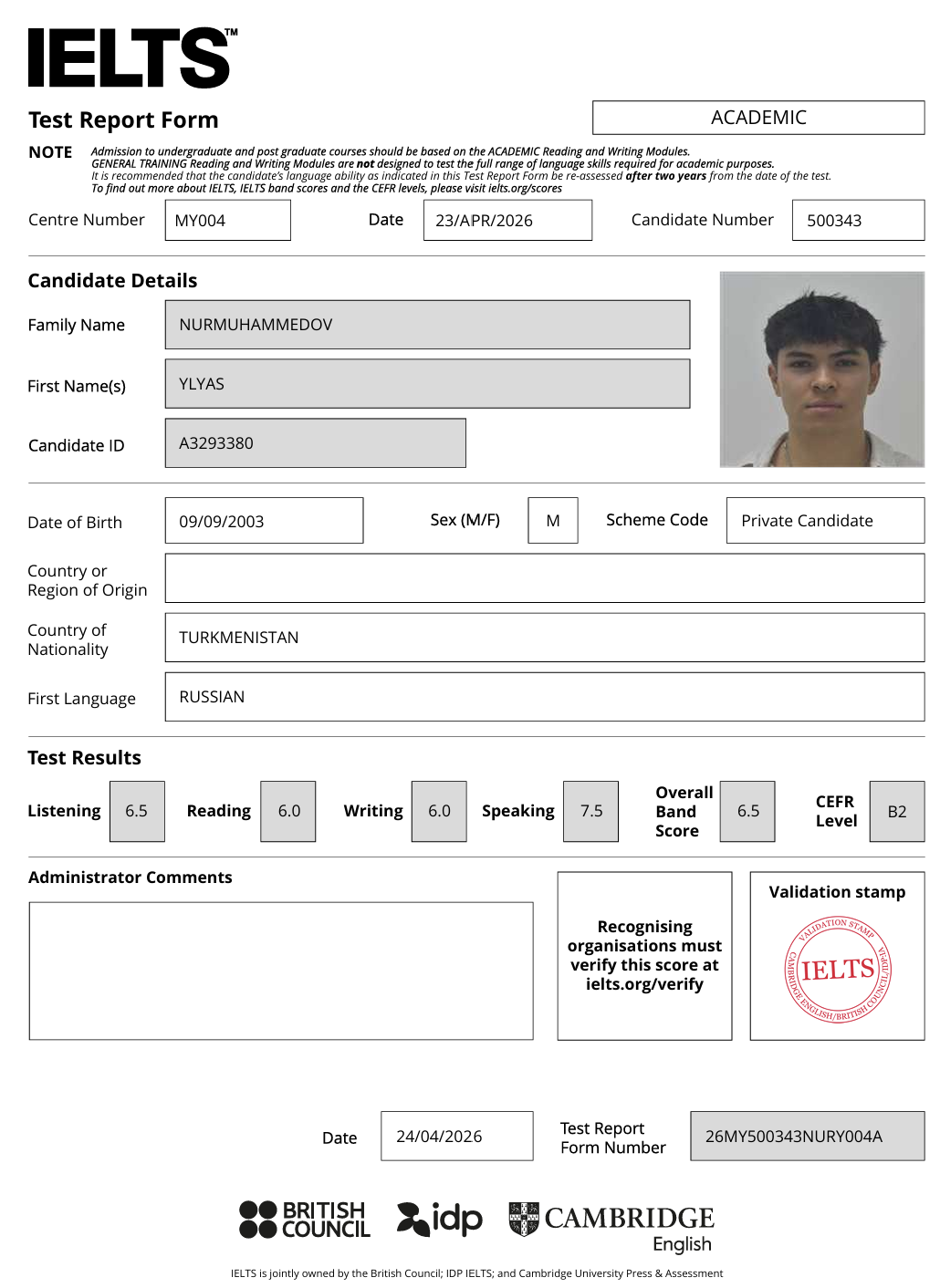
IELTS Academic certificate

IELTS Academic

Overall Band 6.5 · Speaking 7.5 · CEFR B2
🛡️

ELITE Certified SOC Administrator

Tecforte · Currently Pursuing

Let's talk

Whether it's a role, a project, or just a good conversation about secure systems — my inbox is open.

nurmuhammedovylyas0909@gmail.com